A plot item, that represents a series of points. More...
#include <qwt_plot_curve.h>
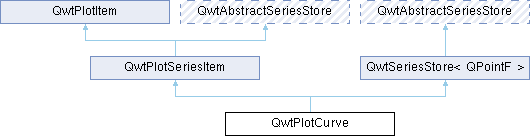
Classes | |
| class | PrivateData |
Public Member Functions | |
| QwtPlotCurve (const QString &title=QString()) | |
| Constructor. | |
| QwtPlotCurve (const QwtText &title) | |
| Constructor. | |
| virtual | ~QwtPlotCurve () |
| Destructor. | |
| virtual int | rtti () const QWT_OVERRIDE |
| void | setPaintAttribute (PaintAttribute, bool on=true) |
| Specify an attribute how to draw the curve. | |
| bool | testPaintAttribute (PaintAttribute) const |
| void | setLegendAttribute (LegendAttribute, bool on=true) |
| Specify an attribute how to draw the legend icon. | |
| bool | testLegendAttribute (LegendAttribute) const |
| void | setLegendAttributes (LegendAttributes) |
| Specify the attributes how to draw the legend icon. | |
| LegendAttributes | legendAttributes () const |
| void | setRawSamples (const double *xData, const double *yData, int size) |
| Initialize the data by pointing to memory blocks which are not managed by QwtPlotCurve. | |
| void | setRawSamples (const float *xData, const float *yData, int size) |
| Initialize the data by pointing to memory blocks which are not managed by QwtPlotCurve. | |
| void | setRawSamples (const double *yData, int size) |
| Initialize the data by pointing to a memory block which is not managed by QwtPlotCurve. | |
| void | setRawSamples (const float *yData, int size) |
| Initialize the data by pointing to memory blocks which are not managed by QwtPlotCurve. | |
| void | setSamples (const double *xData, const double *yData, int size) |
| Set data by copying x- and y-values from specified memory blocks. | |
| void | setSamples (const float *xData, const float *yData, int size) |
| Set data by copying x- and y-values from specified memory blocks. | |
| void | setSamples (const double *yData, int size) |
| Set data by copying y-values from a specified memory block. | |
| void | setSamples (const float *yData, int size) |
| Set data by copying y-values from a specified memory block. | |
| void | setSamples (const QVector< double > &yData) |
| Initialize data with an array of y values (explicitly shared) | |
| void | setSamples (const QVector< float > &yData) |
| Initialize data with an array of y values (explicitly shared) | |
| void | setSamples (const QVector< double > &xData, const QVector< double > &yData) |
| Initialize data with x- and y-arrays (explicitly shared) | |
| void | setSamples (const QVector< float > &xData, const QVector< float > &yData) |
| Initialize data with x- and y-arrays (explicitly shared) | |
| void | setSamples (QVector< double > &&xData, QVector< double > &&yData) |
| Initialize data with x- and y-arrays (explicitly shared) | |
| void | setSamples (QVector< float > &&xData, QVector< float > &&yData) |
| Initialize data with x- and y-arrays (explicitly shared) | |
| void | setSamples (QVector< QPointF > &&) |
| Initialize data with an array of points. | |
| void | setSamples (const QVector< QPointF > &) |
| Initialize data with an array of points. | |
| void | setSamples (QwtSeriesData< QPointF > *) |
| Assign a series of points. | |
| virtual int | closestPoint (const QPointF &pos, double *dist=NULL) const |
| Find the closest curve point for a specific position. | |
| double | minXValue () const |
| boundingRect().left() | |
| double | maxXValue () const |
| boundingRect().right() | |
| double | minYValue () const |
| boundingRect().top() | |
| double | maxYValue () const |
| boundingRect().bottom() | |
| void | setCurveAttribute (CurveAttribute, bool on=true) |
| Specify an attribute for drawing the curve. | |
| bool | testCurveAttribute (CurveAttribute) const |
| void | setPen (const QColor &, qreal width=0.0, Qt::PenStyle=Qt::SolidLine) |
| Build and assign a pen. | |
| void | setPen (const QPen &) |
| Assign a pen. | |
| const QPen & | pen () const |
| void | setBrush (const QBrush &) |
| Assign a brush. | |
| const QBrush & | brush () const |
| void | setBaseline (double) |
| Set the value of the baseline. | |
| double | baseline () const |
| void | setStyle (CurveStyle style) |
| Set the curve's drawing style. | |
| CurveStyle | style () const |
| void | setSymbol (QwtSymbol *) |
| Assign a symbol. | |
| const QwtSymbol * | symbol () const |
| void | setCurveFitter (QwtCurveFitter *) |
| Assign a curve fitter. | |
| QwtCurveFitter * | curveFitter () const |
| Get the curve fitter. | |
| virtual void | drawSeries (QPainter *, const QwtScaleMap &xMap, const QwtScaleMap &yMap, const QRectF &canvasRect, int from, int to) const QWT_OVERRIDE |
| Draw an interval of the curve. | |
| virtual QwtGraphic | legendIcon (int index, const QSizeF &) const QWT_OVERRIDE |
 Public Member Functions inherited from QwtPlotSeriesItem Public Member Functions inherited from QwtPlotSeriesItem | |
| QwtPlotSeriesItem (const QString &title=QString()) | |
| Constructor. | |
| QwtPlotSeriesItem (const QwtText &title) | |
| Constructor. | |
| virtual | ~QwtPlotSeriesItem () |
| Destructor. | |
| void | setOrientation (Qt::Orientation) |
| Set the orientation of the item. | |
| Qt::Orientation | orientation () const |
| virtual void | draw (QPainter *, const QwtScaleMap &xMap, const QwtScaleMap &yMap, const QRectF &canvasRect) const QWT_OVERRIDE |
| Draw the complete series. | |
| virtual QRectF | boundingRect () const QWT_OVERRIDE |
| virtual void | updateScaleDiv (const QwtScaleDiv &, const QwtScaleDiv &) QWT_OVERRIDE |
| Update the item to changes of the axes scale division. | |
| Public Member Functions inherited from QwtPlotItem | |
| QwtPlotItem () | |
| Constructor. | |
| QwtPlotItem (const QString &title) | |
| Constructor. | |
| QwtPlotItem (const QwtText &title) | |
| Constructor. | |
| virtual | ~QwtPlotItem () |
| Destroy the QwtPlotItem. | |
| void | attach (QwtPlot *plot) |
| Attach the item to a plot. | |
| void | detach () |
| This method detaches a QwtPlotItem from any QwtPlot it has been associated with. | |
| QwtPlot * | plot () const |
| Return attached plot. | |
| void | setTitle (const QString &title) |
| Set a new title. | |
| void | setTitle (const QwtText &title) |
| Set a new title. | |
| const QwtText & | title () const |
| void | setItemAttribute (ItemAttribute, bool on=true) |
| Toggle an item attribute. | |
| bool | testItemAttribute (ItemAttribute) const |
| Test an item attribute. | |
| void | setItemInterest (ItemInterest, bool on=true) |
| Toggle an item interest. | |
| bool | testItemInterest (ItemInterest) const |
| Test an item interest. | |
| void | setRenderHint (RenderHint, bool on=true) |
| Toggle an render hint. | |
| bool | testRenderHint (RenderHint) const |
| Test a render hint. | |
| void | setRenderThreadCount (uint numThreads) |
| On multi core systems rendering of certain plot item ( f.e QwtPlotRasterItem ) can be done in parallel in several threads. | |
| uint | renderThreadCount () const |
| void | setLegendIconSize (const QSize &) |
| Set the size of the legend icon. | |
| QSize | legendIconSize () const |
| double | z () const |
| Plot items are painted in increasing z-order. | |
| void | setZ (double z) |
| Set the z value. | |
| void | show () |
| Show the item. | |
| void | hide () |
| Hide the item. | |
| virtual void | setVisible (bool) |
| Show/Hide the item. | |
| bool | isVisible () const |
| void | setAxes (QwtAxisId xAxis, QwtAxisId yAxis) |
| Set X and Y axis. | |
| void | setXAxis (QwtAxisId) |
| Set the X axis. | |
| QwtAxisId | xAxis () const |
| Return xAxis. | |
| void | setYAxis (QwtAxisId) |
| Set the Y axis. | |
| QwtAxisId | yAxis () const |
| Return yAxis. | |
| virtual void | itemChanged () |
| Update the legend and call QwtPlot::autoRefresh() for the parent plot. | |
| virtual void | legendChanged () |
| Update the legend of the parent plot. | |
| virtual void | getCanvasMarginHint (const QwtScaleMap &xMap, const QwtScaleMap &yMap, const QRectF &canvasRect, double &left, double &top, double &right, double &bottom) const |
| Calculate a hint for the canvas margin. | |
| virtual void | updateLegend (const QwtPlotItem *, const QList< QwtLegendData > &) |
| Update the item to changes of the legend info. | |
| QRectF | scaleRect (const QwtScaleMap &, const QwtScaleMap &) const |
| Calculate the bounding scale rectangle of 2 maps. | |
| QRectF | paintRect (const QwtScaleMap &, const QwtScaleMap &) const |
| Calculate the bounding paint rectangle of 2 maps. | |
| virtual QList< QwtLegendData > | legendData () const |
| Return all information, that is needed to represent the item on the legend. | |
| Public Member Functions inherited from QwtAbstractSeriesStore | |
| virtual | ~QwtAbstractSeriesStore () |
| Destructor. | |
| Public Member Functions inherited from QwtSeriesStore< QPointF > | |
| QwtSeriesStore () | |
| Constructor The store contains no series. | |
| ~QwtSeriesStore () | |
| Destructor. | |
| void | setData (QwtSeriesData< QPointF > *series) |
| Assign a series of samples. | |
| QwtSeriesData< QPointF > * | data () |
| const QwtSeriesData< QPointF > * | data () const |
| QPointF | sample (size_t index) const |
| virtual size_t | dataSize () const QWT_OVERRIDE |
| virtual QRectF | dataRect () const QWT_OVERRIDE |
| virtual void | setRectOfInterest (const QRectF &rect) QWT_OVERRIDE |
| Set a the "rect of interest" for the series. | |
| QwtSeriesData< QPointF > * | swapData (QwtSeriesData< QPointF > *series) |
| Replace a series without deleting the previous one. | |
Protected Member Functions | |
| void | init () |
| Initialize internal members. | |
| virtual void | drawCurve (QPainter *, int style, const QwtScaleMap &xMap, const QwtScaleMap &yMap, const QRectF &canvasRect, int from, int to) const |
| Draw the line part (without symbols) of a curve interval. | |
| virtual void | drawSymbols (QPainter *, const QwtSymbol &, const QwtScaleMap &xMap, const QwtScaleMap &yMap, const QRectF &canvasRect, int from, int to) const |
| Draw symbols. | |
| virtual void | drawLines (QPainter *, const QwtScaleMap &xMap, const QwtScaleMap &yMap, const QRectF &canvasRect, int from, int to) const |
| Draw lines. | |
| virtual void | drawSticks (QPainter *, const QwtScaleMap &xMap, const QwtScaleMap &yMap, const QRectF &canvasRect, int from, int to) const |
| Draw sticks. | |
| virtual void | drawDots (QPainter *, const QwtScaleMap &xMap, const QwtScaleMap &yMap, const QRectF &canvasRect, int from, int to) const |
| Draw dots. | |
| virtual void | drawSteps (QPainter *, const QwtScaleMap &xMap, const QwtScaleMap &yMap, const QRectF &canvasRect, int from, int to) const |
| Draw step function. | |
| virtual void | fillCurve (QPainter *, const QwtScaleMap &, const QwtScaleMap &, const QRectF &canvasRect, QPolygonF &) const |
| Fill the area between the curve and the baseline with the curve brush. | |
| void | closePolyline (QPainter *, const QwtScaleMap &, const QwtScaleMap &, QPolygonF &) const |
| Complete a polygon to be a closed polygon including the area between the original polygon and the baseline. | |
| Protected Member Functions inherited from QwtPlotSeriesItem | |
| virtual void | dataChanged () QWT_OVERRIDE |
| dataChanged() indicates, that the series has been changed. | |
| Protected Member Functions inherited from QwtPlotItem | |
| QwtGraphic | defaultIcon (const QBrush &, const QSizeF &) const |
| Return a default icon from a brush. | |
Detailed Description
A plot item, that represents a series of points.
A curve is the representation of a series of points in the x-y plane. It supports different display styles, interpolation ( f.e. spline ) and symbols.
- Usage
- a) Assign curve properties
- When a curve is created, it is configured to draw black solid lines with in QwtPlotCurve::Lines style and no symbols. You can change this by calling setPen(), setStyle() and setSymbol().
- b) Connect/Assign data.
- QwtPlotCurve gets its points using a QwtSeriesData object offering a bridge to the real storage of the points ( like QAbstractItemModel ). There are several convenience classes derived from QwtSeriesData, that also store the points inside ( like QStandardItemModel ). QwtPlotCurve also offers a couple of variations of setSamples(), that build QwtSeriesData objects from arrays internally.
- c) Attach the curve to a plot
- See QwtPlotItem::attach()
- Example:
- see examples/bode
- See also
- QwtPointSeriesData, QwtSymbol, QwtScaleMap
Member Enumeration Documentation
◆ CurveAttribute
Attribute for drawing the curve.
| Enumerator | |
|---|---|
| Inverted | For QwtPlotCurve::Steps only. Draws a step function from the right to the left. |
| Fitted | Only in combination with QwtPlotCurve::Lines A QwtCurveFitter tries to interpolate/smooth the curve, before it is painted.
|
◆ CurveStyle
Curve styles.
- See also
- setStyle(), style()
| Enumerator | |
|---|---|
| NoCurve | Don't draw a curve. Note: This doesn't affect the symbols. |
| Lines | Connect the points with straight lines. The lines might be interpolated depending on the 'Fitted' attribute. Curve fitting can be configured using setCurveFitter(). |
| Sticks | Draw vertical or horizontal sticks ( depending on the orientation() ) from a baseline which is defined by setBaseline(). |
| Steps | Connect the points with a step function. The step function is drawn from the left to the right or vice versa, depending on the QwtPlotCurve::Inverted attribute. |
| Dots | Draw dots at the locations of the data points. Note: This is different from a dotted line (see setPen()), and faster as a curve in QwtPlotCurve::NoStyle style and a symbol painting a point. |
| UserCurve | Styles >= QwtPlotCurve::UserCurve are reserved for derived classes of QwtPlotCurve that overload drawCurve() with additional application specific curve types. |
◆ LegendAttribute
Attributes how to represent the curve on the legend.
| Enumerator | |
|---|---|
| LegendNoAttribute | QwtPlotCurve tries to find a color representing the curve and paints a rectangle with it. |
| LegendShowLine | If the style() is not QwtPlotCurve::NoCurve a line is painted with the curve pen(). |
| LegendShowSymbol | If the curve has a valid symbol it is painted. |
| LegendShowBrush | If the curve has a brush a rectangle filled with the curve brush() is painted. |
◆ PaintAttribute
Attributes to modify the drawing algorithm.
The default setting enables ClipPolygons | FilterPoints
- See also
- setPaintAttribute(), testPaintAttribute()
| Enumerator | |
|---|---|
| ClipPolygons | Clip polygons before painting them. In situations, where points are far outside the visible area (f.e when zooming deep) this might be a substantial improvement for the painting performance |
| FilterPoints | Tries to reduce the data that has to be painted, by sorting out duplicates, or paintings outside the visible area. Might have a notable impact on curves with many close points. Only a couple of very basic filtering algorithms are implemented. |
| MinimizeMemory | Minimize memory usage that is temporarily needed for the translated points, before they get painted. This might slow down the performance of painting |
| ImageBuffer | Render the points to a temporary image and paint the image. This is a very special optimization for Dots style, when having a huge amount of points. With a reasonable number of points QPainter::drawPoints() will be faster. |
| FilterPointsAggressive | More aggressive point filtering trying to filter out intermediate points, accepting minor visual differences. Has only an effect, when drawing the curve to a paint device in integer coordinates ( f.e. all widgets on screen ) using the fact, that consecutive points are often mapped to the same x or y coordinate. Each chunk of samples mapped to the same coordinate can be reduced to 4 points ( first, min, max last ). In the worst case the polygon to be rendered will be 4 times the width of the plot canvas. The algorithm is very fast and effective for huge datasets, and can be used inside a replot cycle.
|
Constructor & Destructor Documentation
◆ QwtPlotCurve() [1/2]
|
explicit |
Constructor.
- Parameters
-
title Title of the curve
◆ QwtPlotCurve() [2/2]
|
explicit |
Constructor.
- Parameters
-
title Title of the curve
Member Function Documentation
◆ baseline()
| double QwtPlotCurve::baseline | ( | ) | const |
- Returns
- Value of the baseline
- See also
- setBaseline()
◆ brush()
| const QBrush & QwtPlotCurve::brush | ( | ) | const |
- Returns
- Brush used to fill the area between lines and the baseline
- See also
- setBrush(), setBaseline(), baseline()
◆ closePolyline()
|
protected |
Complete a polygon to be a closed polygon including the area between the original polygon and the baseline.
- Parameters
-
painter Painter xMap X map yMap Y map polygon Polygon to be completed
◆ closestPoint()
|
virtual |
Find the closest curve point for a specific position.
- Parameters
-
pos Position, where to look for the closest curve point dist If dist != NULL, closestPoint() returns the distance between the position and the closest curve point
- Returns
- Index of the closest curve point, or -1 if none can be found ( f.e when the curve has no points )
- Note
- closestPoint() implements a dumb algorithm, that iterates over all points
◆ curveFitter()
| QwtCurveFitter * QwtPlotCurve::curveFitter | ( | ) | const |
Get the curve fitter.
If curve fitting is disabled NULL is returned.
- Returns
- Curve fitter
- See also
- setCurveFitter(), Fitted
◆ drawCurve()
|
protectedvirtual |
Draw the line part (without symbols) of a curve interval.
- Parameters
-
painter Painter style curve style, see QwtPlotCurve::CurveStyle xMap x map yMap y map canvasRect Contents rectangle of the canvas from index of the first point to be painted to index of the last point to be painted
- See also
- draw(), drawDots(), drawLines(), drawSteps(), drawSticks()
◆ drawDots()
|
protectedvirtual |
Draw dots.
- Parameters
-
painter Painter xMap x map yMap y map canvasRect Contents rectangle of the canvas from index of the first point to be painted to index of the last point to be painted
- See also
- draw(), drawCurve(), drawSticks(), drawLines(), drawSteps()
◆ drawLines()
|
protectedvirtual |
Draw lines.
If the CurveAttribute Fitted is enabled a QwtCurveFitter tries to interpolate/smooth the curve, before it is painted.
- Parameters
-
painter Painter xMap x map yMap y map canvasRect Contents rectangle of the canvas from index of the first point to be painted to index of the last point to be painted
◆ drawSeries()
|
virtual |
Draw an interval of the curve.
- Parameters
-
painter Painter xMap Maps x-values into pixel coordinates. yMap Maps y-values into pixel coordinates. canvasRect Contents rectangle of the canvas from Index of the first point to be painted to Index of the last point to be painted. If to < 0 the curve will be painted to its last point.
- See also
- drawCurve(), drawSymbols(),
Implements QwtPlotSeriesItem.
◆ drawSteps()
|
protectedvirtual |
Draw step function.
The direction of the steps depends on Inverted attribute.
- Parameters
-
painter Painter xMap x map yMap y map canvasRect Contents rectangle of the canvas from index of the first point to be painted to index of the last point to be painted
◆ drawSticks()
|
protectedvirtual |
Draw sticks.
- Parameters
-
painter Painter xMap x map yMap y map canvasRect Contents rectangle of the canvas from index of the first point to be painted to index of the last point to be painted
- See also
- draw(), drawCurve(), drawDots(), drawLines(), drawSteps()
◆ drawSymbols()
|
protectedvirtual |
Draw symbols.
- Parameters
-
painter Painter symbol Curve symbol xMap x map yMap y map canvasRect Contents rectangle of the canvas from Index of the first point to be painted to Index of the last point to be painted
- See also
- setSymbol(), drawSeries(), drawCurve()
◆ fillCurve()
|
protectedvirtual |
Fill the area between the curve and the baseline with the curve brush.
- Parameters
-
painter Painter xMap x map yMap y map canvasRect Contents rectangle of the canvas polygon Polygon - will be modified !
- See also
- setBrush(), setBaseline(), setStyle()
◆ legendAttributes()
| QwtPlotCurve::LegendAttributes QwtPlotCurve::legendAttributes | ( | ) | const |
- Returns
- Attributes how to draw the legend icon
◆ legendIcon()
|
virtual |
- Returns
- Icon representing the curve on the legend
- Parameters
-
index Index of the legend entry ( ignored as there is only one ) size Icon size
Reimplemented from QwtPlotItem.
◆ pen()
| const QPen & QwtPlotCurve::pen | ( | ) | const |
◆ rtti()
|
virtual |
- Returns
- QwtPlotItem::Rtti_PlotCurve
Reimplemented from QwtPlotItem.
◆ setBaseline()
| void QwtPlotCurve::setBaseline | ( | double | value | ) |
Set the value of the baseline.
The baseline is needed for filling the curve with a brush or the Sticks drawing style.
The interpretation of the baseline depends on the orientation(). With Qt::Vertical, the baseline is interpreted as a horizontal line at y = baseline(), with Qt::Horizontal, it is interpreted as a vertical line at x = baseline().
The default value is 0.0.
- Parameters
-
value Value of the baseline
- See also
- baseline(), setBrush(), setStyle(), QwtPlotAbstractSeriesItem::orientation()
◆ setBrush()
| void QwtPlotCurve::setBrush | ( | const QBrush & | brush | ) |
Assign a brush.
In case of brush.style() != QBrush::NoBrush and style() != QwtPlotCurve::Sticks the area between the curve and the baseline will be filled.
In case !brush.color().isValid() the area will be filled by pen.color(). The fill algorithm simply connects the first and the last curve point to the baseline. So the curve data has to be sorted (ascending or descending).
- Parameters
-
brush New brush
- See also
- brush(), setBaseline(), baseline()
◆ setCurveAttribute()
| void QwtPlotCurve::setCurveAttribute | ( | CurveAttribute | attribute, |
| bool | on = true |
||
| ) |
Specify an attribute for drawing the curve.
- Parameters
-
attribute Curve attribute on On/Off
◆ setCurveFitter()
| void QwtPlotCurve::setCurveFitter | ( | QwtCurveFitter * | curveFitter | ) |
Assign a curve fitter.
The curve fitter "smooths" the curve points, when the Fitted CurveAttribute is set. setCurveFitter(NULL) also disables curve fitting.
The curve fitter operates on the translated points ( = widget coordinates) to be functional for logarithmic scales. Obviously this is less performant for fitting algorithms, that reduce the number of points.
For situations, where curve fitting is used to improve the performance of painting huge series of points it might be better to execute the fitter on the curve points once and to cache the result in the QwtSeriesData object.
- Parameters
-
curveFitter() Curve fitter
- See also
- Fitted
◆ setLegendAttribute()
| void QwtPlotCurve::setLegendAttribute | ( | LegendAttribute | attribute, |
| bool | on = true |
||
| ) |
Specify an attribute how to draw the legend icon.
- Parameters
-
attribute Attribute on On/Off /sa testLegendAttribute(). legendIcon()
◆ setLegendAttributes()
| void QwtPlotCurve::setLegendAttributes | ( | LegendAttributes | attributes | ) |
Specify the attributes how to draw the legend icon.
- Parameters
-
attributes Attributes /sa setLegendAttribute(). legendIcon()
◆ setPaintAttribute()
| void QwtPlotCurve::setPaintAttribute | ( | PaintAttribute | attribute, |
| bool | on = true |
||
| ) |
Specify an attribute how to draw the curve.
- Parameters
-
attribute Paint attribute on On/Off
- See also
- testPaintAttribute()
◆ setPen() [1/2]
| void QwtPlotCurve::setPen | ( | const QColor & | color, |
| qreal | width = 0.0, |
||
| Qt::PenStyle | style = Qt::SolidLine |
||
| ) |
◆ setPen() [2/2]
| void QwtPlotCurve::setPen | ( | const QPen & | pen | ) |
◆ setRawSamples() [1/4]
| void QwtPlotCurve::setRawSamples | ( | const double * | xData, |
| const double * | yData, | ||
| int | size | ||
| ) |
Initialize the data by pointing to memory blocks which are not managed by QwtPlotCurve.
setRawSamples is provided for efficiency. It is important to keep the pointers during the lifetime of the underlying QwtCPointerData class.
- Parameters
-
xData pointer to x data yData pointer to y data size size of x and y
- See also
- QwtCPointerData
◆ setRawSamples() [2/4]
| void QwtPlotCurve::setRawSamples | ( | const double * | yData, |
| int | size | ||
| ) |
Initialize the data by pointing to a memory block which is not managed by QwtPlotCurve.
The memory contains the y coordinates, while the index is interpreted as x coordinate.
setRawSamples() is provided for efficiency. It is important to keep the pointers during the lifetime of the underlying QwtCPointerValueData class.
- Parameters
-
yData pointer to y data size size of x and y
- See also
- QwtCPointerData
◆ setRawSamples() [3/4]
| void QwtPlotCurve::setRawSamples | ( | const float * | xData, |
| const float * | yData, | ||
| int | size | ||
| ) |
Initialize the data by pointing to memory blocks which are not managed by QwtPlotCurve.
setRawSamples is provided for efficiency. It is important to keep the pointers during the lifetime of the underlying QwtCPointerData class.
- Parameters
-
xData pointer to x data yData pointer to y data size size of x and y
- See also
- QwtCPointerData
◆ setRawSamples() [4/4]
| void QwtPlotCurve::setRawSamples | ( | const float * | yData, |
| int | size | ||
| ) |
Initialize the data by pointing to memory blocks which are not managed by QwtPlotCurve.
The memory contains the y coordinates, while the index is interpreted as x coordinate.
setRawSamples() is provided for efficiency. It is important to keep the pointers during the lifetime of the underlying QwtCPointerValueData class.
- Parameters
-
yData pointer to y data size size of x and y
- See also
- QwtCPointerData
◆ setSamples() [1/13]
| void QwtPlotCurve::setSamples | ( | const double * | xData, |
| const double * | yData, | ||
| int | size | ||
| ) |
Set data by copying x- and y-values from specified memory blocks.
Contrary to setRawSamples(), this function makes a 'deep copy' of the data.
- Parameters
-
xData pointer to x values yData pointer to y values size size of xData and yData
- See also
- QwtPointArrayData
◆ setSamples() [2/13]
| void QwtPlotCurve::setSamples | ( | const double * | yData, |
| int | size | ||
| ) |
Set data by copying y-values from a specified memory block.
The memory contains the y coordinates, while the index is interpreted as x coordinate.
- Parameters
-
yData y data size size of yData
- See also
- QwtValuePointData
◆ setSamples() [3/13]
| void QwtPlotCurve::setSamples | ( | const float * | xData, |
| const float * | yData, | ||
| int | size | ||
| ) |
Set data by copying x- and y-values from specified memory blocks.
Contrary to setRawSamples(), this function makes a 'deep copy' of the data.
- Parameters
-
xData pointer to x values yData pointer to y values size size of xData and yData
- See also
- QwtPointArrayData
◆ setSamples() [4/13]
| void QwtPlotCurve::setSamples | ( | const float * | yData, |
| int | size | ||
| ) |
Set data by copying y-values from a specified memory block.
The vector contains the y coordinates, while the index is interpreted as x coordinate.
- Parameters
-
yData y data size size of yData
- See also
- QwtValuePointData
◆ setSamples() [5/13]
Initialize data with x- and y-arrays (explicitly shared)
- Parameters
-
xData x data yData y data
- See also
- QwtPointArrayData
◆ setSamples() [6/13]
| void QwtPlotCurve::setSamples | ( | const QVector< double > & | yData | ) |
Initialize data with an array of y values (explicitly shared)
The vector contains the y coordinates, while the index is the x coordinate.
- Parameters
-
yData y data
- See also
- QwtValuePointData
◆ setSamples() [7/13]
Initialize data with x- and y-arrays (explicitly shared)
- Parameters
-
xData x data yData y data
- See also
- QwtPointArrayData
◆ setSamples() [8/13]
| void QwtPlotCurve::setSamples | ( | const QVector< float > & | yData | ) |
Initialize data with an array of y values (explicitly shared)
The vector contains the y coordinates, while the index is the x coordinate.
- Parameters
-
yData y data
- See also
- QwtValuePointData
◆ setSamples() [9/13]
| void QwtPlotCurve::setSamples | ( | const QVector< QPointF > & | samples | ) |
Initialize data with an array of points.
- Parameters
-
samples Vector of points
- Note
- QVector is implicitly shared
- QPolygonF is derived from QVector<QPointF>
◆ setSamples() [10/13]
Initialize data with x- and y-arrays (explicitly shared)
- Parameters
-
xData x data yData y data
- See also
- QwtPointArrayData
◆ setSamples() [11/13]
Initialize data with x- and y-arrays (explicitly shared)
- Parameters
-
xData x data yData y data
- See also
- QwtPointArrayData
◆ setSamples() [12/13]
| void QwtPlotCurve::setSamples | ( | QVector< QPointF > && | samples | ) |
Initialize data with an array of points.
- Parameters
-
samples Vector of points
- Note
- QVector is implicitly shared
- QPolygonF is derived from QVector<QPointF>
◆ setSamples() [13/13]
| void QwtPlotCurve::setSamples | ( | QwtSeriesData< QPointF > * | data | ) |
Assign a series of points.
setSamples() is just a wrapper for setData() without any additional value - beside that it is easier to find for the developer.
- Parameters
-
data Data
- Warning
- The item takes ownership of the data object, deleting it when its not used anymore.
◆ setStyle()
| void QwtPlotCurve::setStyle | ( | CurveStyle | style | ) |
◆ setSymbol()
| void QwtPlotCurve::setSymbol | ( | QwtSymbol * | symbol | ) |
Assign a symbol.
The curve will take the ownership of the symbol, hence the previously set symbol will be delete by setting a new one. If symbol is NULL no symbol will be drawn.
- Parameters
-
symbol Symbol
- See also
- symbol()
◆ style()
| QwtPlotCurve::CurveStyle QwtPlotCurve::style | ( | ) | const |
- Returns
- Style of the curve
- See also
- setStyle()
◆ symbol()
| const QwtSymbol * QwtPlotCurve::symbol | ( | ) | const |
- Returns
- Current symbol or NULL, when no symbol has been assigned
- See also
- setSymbol()
◆ testCurveAttribute()
| bool QwtPlotCurve::testCurveAttribute | ( | CurveAttribute | attribute | ) | const |
- Returns
- true, if attribute is enabled
- See also
- setCurveAttribute()
◆ testLegendAttribute()
| bool QwtPlotCurve::testLegendAttribute | ( | LegendAttribute | attribute | ) | const |
- Returns
- True, when attribute is enabled
- See also
- setLegendAttribute()
◆ testPaintAttribute()
| bool QwtPlotCurve::testPaintAttribute | ( | PaintAttribute | attribute | ) | const |
- Returns
- True, when attribute is enabled
- See also
- setPaintAttribute()
The documentation for this class was generated from the following files:
- /home/runner/work/QWT/QWT/src/qwt_plot_curve.h
- /home/runner/work/QWT/QWT/src/qwt_plot_curve.cpp