Base class for all splines. More...
#include <qwt_spline.h>
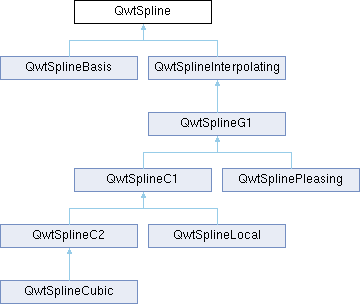
Classes | |
| class | PrivateData |
Public Types | |
| enum | BoundaryType { ConditionalBoundaries , PeriodicPolygon , ClosedPolygon } |
| Boundary type specifying the spline at its endpoints. More... | |
| enum | BoundaryPosition { AtBeginning , AtEnd } |
| position of a boundary condition More... | |
| enum | BoundaryCondition { Clamped1 , Clamped2 , Clamped3 , LinearRunout } |
| Boundary condition. More... | |
Public Member Functions | |
| QwtSpline () | |
| Constructor. | |
| virtual | ~QwtSpline () |
| Destructor. | |
| void | setParametrization (int type) |
| Set parametrization by type. | |
| void | setParametrization (QwtSplineParametrization *) |
| Set parametrization object. | |
| const QwtSplineParametrization * | parametrization () const |
| Get parametrization. | |
| void | setBoundaryType (BoundaryType) |
| Set boundary type. | |
| BoundaryType | boundaryType () const |
| Get boundary type. | |
| void | setBoundaryValue (BoundaryPosition, double value) |
| Set boundary value. | |
| double | boundaryValue (BoundaryPosition) const |
| Get boundary value. | |
| void | setBoundaryCondition (BoundaryPosition, int condition) |
| Set boundary condition. | |
| int | boundaryCondition (BoundaryPosition) const |
| Get boundary condition. | |
| void | setBoundaryConditions (int condition, double valueBegin=0.0, double valueEnd=0.0) |
| Set boundary conditions for both ends. | |
| virtual QPolygonF | polygon (const QPolygonF &, double tolerance) const |
| Get polygon approximation with tolerance. | |
| virtual QPainterPath | painterPath (const QPolygonF &) const =0 |
| Get painter path from polygon (pure virtual) | |
| virtual uint | locality () const |
| Get locality (number of points used for calculation) | |
Detailed Description
Base class for all splines.
A spline is a curve represented by a sequence of polynomials. Spline approximation is the process of finding polynomials for a given set of points. When the algorithm preserves the initial points it is called interpolating.
Splines can be classified according to conditions of the polynomials that are met at the start/endpoints of the pieces:
- Geometric Continuity
- G0: polynomials are joined
- G1: first derivatives are proportional at the join point The curve tangents thus have the same direction, but not necessarily the same magnitude. i.e., C1'(1) = (a,b,c) and C2'(0) = (k*a, k*b, k*c).
- G2: first and second derivatives are proportional at join point
- Parametric Continuity
- C0: curves are joined
- C1: first derivatives equal
- C2: first and second derivatives are equal
Geometric continuity requires the geometry to be continuous, while parametric continuity requires that the underlying parameterization be continuous as well. Parametric continuity of order n implies geometric continuity of order n, but not vice-versa.
QwtSpline is the base class for spline approximations of any continuity.
Member Enumeration Documentation
◆ BoundaryCondition
Boundary condition.
A spline algorithm calculates polynomials by looking a couple of points back/ahead ( locality() ). At the ends additional rules are necessary to compensate the missing points.
| Enumerator | |
|---|---|
| Clamped1 | The first derivative at the end point is given
|
| Clamped2 | The second derivative at the end point is given
|
| Clamped3 | The third derivative at the end point is given
|
| LinearRunout | The first derivate at the endpoint is related to the first derivative at its neighbour by the boundary value. F,e when the boundary value at the end is 1.0 then the slope at the last 2 points is the same.
|
◆ BoundaryPosition
position of a boundary condition
- See also
- boundaryCondition(), boundaryValue()
| Enumerator | |
|---|---|
| AtBeginning | the condition is at the beginning of the polynomial |
| AtEnd | the condition is at the end of the polynomial |
◆ BoundaryType
Boundary type specifying the spline at its endpoints.
- See also
- setBoundaryType(), boundaryType()
| Enumerator | |
|---|---|
| ConditionalBoundaries | The polynomials at the start/endpoint depend on specific conditions
|
| PeriodicPolygon | The polynomials at the start/endpoint are found by using imaginary additional points. Additional points at the end are found by translating points from the beginning or v.v. |
| ClosedPolygon | ClosedPolygon is similar to PeriodicPolygon beside, that the interpolation includes the connection between the last and the first control point.
|
Constructor & Destructor Documentation
◆ QwtSpline()
| QwtSpline::QwtSpline | ( | ) |
Constructor.
The default setting is a non-closing spline with chordal parametrization.
- See also
- setParametrization(), setBoundaryType()
Destructor
Member Function Documentation
◆ boundaryCondition()
| int QwtSpline::boundaryCondition | ( | BoundaryPosition | position | ) | const |
Get boundary condition.
- Parameters
-
[in] position At the beginning or the end of the spline
- Returns
- Condition for an endpoint of the spline
◆ boundaryType()
| QwtSpline::BoundaryType QwtSpline::boundaryType | ( | ) | const |
◆ boundaryValue()
| double QwtSpline::boundaryValue | ( | BoundaryPosition | position | ) | const |
Get boundary value.
- Parameters
-
[in] position At the beginning or the end of the spline
- Returns
- Boundary value
- See also
- setBoundaryValue(), boundaryCondition()
◆ locality()
|
virtual |
Get locality (number of points used for calculation)
Get the locality of the spline interpolation.
The locality of a spline interpolation identifies how many adjacent polynomials are affected when changing the position of one point.
A locality of 'n' means that changing the coordinates of a point has an effect on 'n' leading and 'n' following polynomials. Those polynomials can be calculated from a local subpolygon.
A value of 0 means the interpolation is not local and any modification of the polygon requires recalculating all polynomials (e.g., cubic splines).
- Returns
- Order of locality
Reimplemented in QwtSplineBasis, QwtSplineCubic, QwtSplineLocal, and QwtSplinePleasing.
◆ painterPath()
|
pure virtual |
Get painter path from polygon (pure virtual)
Approximates a polygon piecewise with cubic Bezier curves and returns them as QPainterPath.
- Parameters
-
points Control points
- Returns
- Painter path, that can be rendered by QPainter
Implemented in QwtSplineInterpolating, QwtSplineC1, QwtSplineC2, QwtSplineBasis, QwtSplineCubic, QwtSplineLocal, and QwtSplinePleasing.
◆ parametrization()
| const QwtSplineParametrization * QwtSpline::parametrization | ( | ) | const |
◆ polygon()
|
virtual |
Get polygon approximation with tolerance.
Interpolate a curve by a polygon.
Interpolates a polygon piecewise with Bezier curves interpolating them in a 2nd pass by polygons.
The interpolation is based on "Piecewise Linear Approximation of Bezier Curves" by Roger Willcocks ( http://www.rops.org )
- Parameters
-
[in] points Control points [in] tolerance Maximum for the accepted error of the approximation
- Returns
- Polygon approximating the interpolating polynomials
- See also
- bezierControlLines(), QwtBezier
Reimplemented in QwtSplineInterpolating.
◆ setBoundaryCondition()
| void QwtSpline::setBoundaryCondition | ( | BoundaryPosition | position, |
| int | condition | ||
| ) |
Set boundary condition.
Define the condition for an endpoint of the spline.
- Parameters
-
[in] position At the beginning or the end of the spline [in] condition Condition
◆ setBoundaryConditions()
| void QwtSpline::setBoundaryConditions | ( | int | condition, |
| double | valueBegin = 0.0, |
||
| double | valueEnd = 0.0 |
||
| ) |
Set boundary conditions for both ends.
Define the condition at the endpoints of a spline.
- Parameters
-
[in] condition Condition [in] valueBegin Used for the condition at the beginning of the spline [in] valueEnd Used for the condition at the end of the spline
- See also
- BoundaryCondition, QwtSplineC2::BoundaryCondition, testBoundaryCondition(), setBoundaryValue()
◆ setBoundaryType()
| void QwtSpline::setBoundaryType | ( | BoundaryType | boundaryType | ) |
Set boundary type.
Define the boundary type for the endpoints of the approximating spline.
- Parameters
-
[in] boundaryType Boundary type
- See also
- boundaryType()
◆ setBoundaryValue()
| void QwtSpline::setBoundaryValue | ( | BoundaryPosition | position, |
| double | value | ||
| ) |
Set boundary value.
The boundary value is a parameter used in combination with the boundary condition. Its meaning depends on the condition.
- Parameters
-
[in] position At the beginning or the end of the spline [in] value Value used for the condition at the endpoint
- See also
- boundaryValue(), setBoundaryCondition()
◆ setParametrization() [1/2]
| void QwtSpline::setParametrization | ( | int | type | ) |
Set parametrization by type.
Define the parametrization for a parametric spline approximation. The default setting is a chordal parametrization.
- Parameters
-
[in] type Type of parametrization, usually one of QwtSplineParametrization::Type
- See also
- parametrization()
◆ setParametrization() [2/2]
| void QwtSpline::setParametrization | ( | QwtSplineParametrization * | parametrization | ) |
Set parametrization object.
Define the parametrization for a parametric spline approximation. The default setting is a chordal parametrization.
- Parameters
-
[in] parametrization Parametrization object
- See also
- parametrization()
The documentation for this class was generated from the following files:
- /home/runner/work/QWT/QWT/src/plot/qwt_spline.h
- /home/runner/work/QWT/QWT/src/plot/qwt_spline.cpp