A curve fitter implementing Douglas and Peucker algorithm. More...
#include <qwt_weeding_curve_fitter.h>
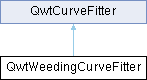
Classes | |
| class | Line |
| class | PrivateData |
Public Member Functions | |
| QwtWeedingCurveFitter (double tolerance=1.0) | |
| Constructor. | |
| virtual | ~QwtWeedingCurveFitter () |
| Destructor. | |
| void | setTolerance (double) |
| Assign the tolerance. | |
| double | tolerance () const |
| void | setChunkSize (uint) |
| Limit the number of points passed to a run of the algorithm. | |
| uint | chunkSize () const |
| virtual QPolygonF | fitCurve (const QPolygonF &) const QWT_OVERRIDE |
| virtual QPainterPath | fitCurvePath (const QPolygonF &) const QWT_OVERRIDE |
 Public Member Functions inherited from QwtCurveFitter Public Member Functions inherited from QwtCurveFitter | |
| virtual | ~QwtCurveFitter () |
| Destructor. | |
| Mode | mode () const |
Additional Inherited Members | |
| Public Types inherited from QwtCurveFitter | |
| enum | Mode { Polygon , Path } |
| Preferred mode of the fitting algorithm. More... | |
| Protected Member Functions inherited from QwtCurveFitter | |
| QwtCurveFitter (Mode mode) | |
| Constructor. | |
Detailed Description
A curve fitter implementing Douglas and Peucker algorithm.
The purpose of the Douglas and Peucker algorithm is that given a 'curve' composed of line segments to find a curve not too dissimilar but that has fewer points. The algorithm defines 'too dissimilar' based on the maximum distance (tolerance) between the original curve and the smoothed curve.
The runtime of the algorithm increases non linear ( worst case O( n*n ) ) and might be very slow for huge polygons. To avoid performance issues it might be useful to split the polygon ( setChunkSize() ) and to run the algorithm for these smaller parts. The disadvantage of having no interpolation at the borders is for most use cases irrelevant.
The smoothed curve consists of a subset of the points that defined the original curve.
In opposite to QwtSplineCurveFitter the Douglas and Peucker algorithm reduces the number of points. By adjusting the tolerance parameter according to the axis scales QwtSplineCurveFitter can be used to implement different level of details to speed up painting of curves of many points.
Constructor & Destructor Documentation
◆ QwtWeedingCurveFitter()
|
explicit |
Member Function Documentation
◆ chunkSize()
| uint QwtWeedingCurveFitter::chunkSize | ( | ) | const |
- Returns
- Maximum for the number of points passed to a run of the algorithm - or 0, when unlimited
- See also
- setChunkSize()
◆ fitCurve()
|
virtual |
- Parameters
-
points Series of data points
- Returns
- Curve points
- See also
- fitCurvePath()
Implements QwtCurveFitter.
◆ fitCurvePath()
|
virtual |
- Parameters
-
points Series of data points
- Returns
- Curve path
- See also
- fitCurve()
Implements QwtCurveFitter.
◆ setChunkSize()
| void QwtWeedingCurveFitter::setChunkSize | ( | uint | numPoints | ) |
Limit the number of points passed to a run of the algorithm.
The runtime of the Douglas Peucker algorithm increases non linear with the number of points. For a chunk size > 0 the polygon is split into pieces passed to the algorithm one by one.
- Parameters
-
numPoints Maximum for the number of points passed to the algorithm
- See also
- chunkSize()
◆ setTolerance()
| void QwtWeedingCurveFitter::setTolerance | ( | double | tolerance | ) |
Assign the tolerance.
The tolerance is the maximum distance, that is acceptable between the original curve and the smoothed curve.
Increasing the tolerance will reduce the number of the resulting points.
- Parameters
-
tolerance Tolerance
- See also
- tolerance()
◆ tolerance()
| double QwtWeedingCurveFitter::tolerance | ( | ) | const |
- Returns
- Tolerance
- See also
- setTolerance()
The documentation for this class was generated from the following files:
- /home/runner/work/QWT/QWT/src/qwt_weeding_curve_fitter.h
- /home/runner/work/QWT/QWT/src/qwt_weeding_curve_fitter.cpp